
The Reason Truly Confident Men Don't Wear Expensive Watches
It has nothing to do with money. It has everything to do with what you need other people to think about you.


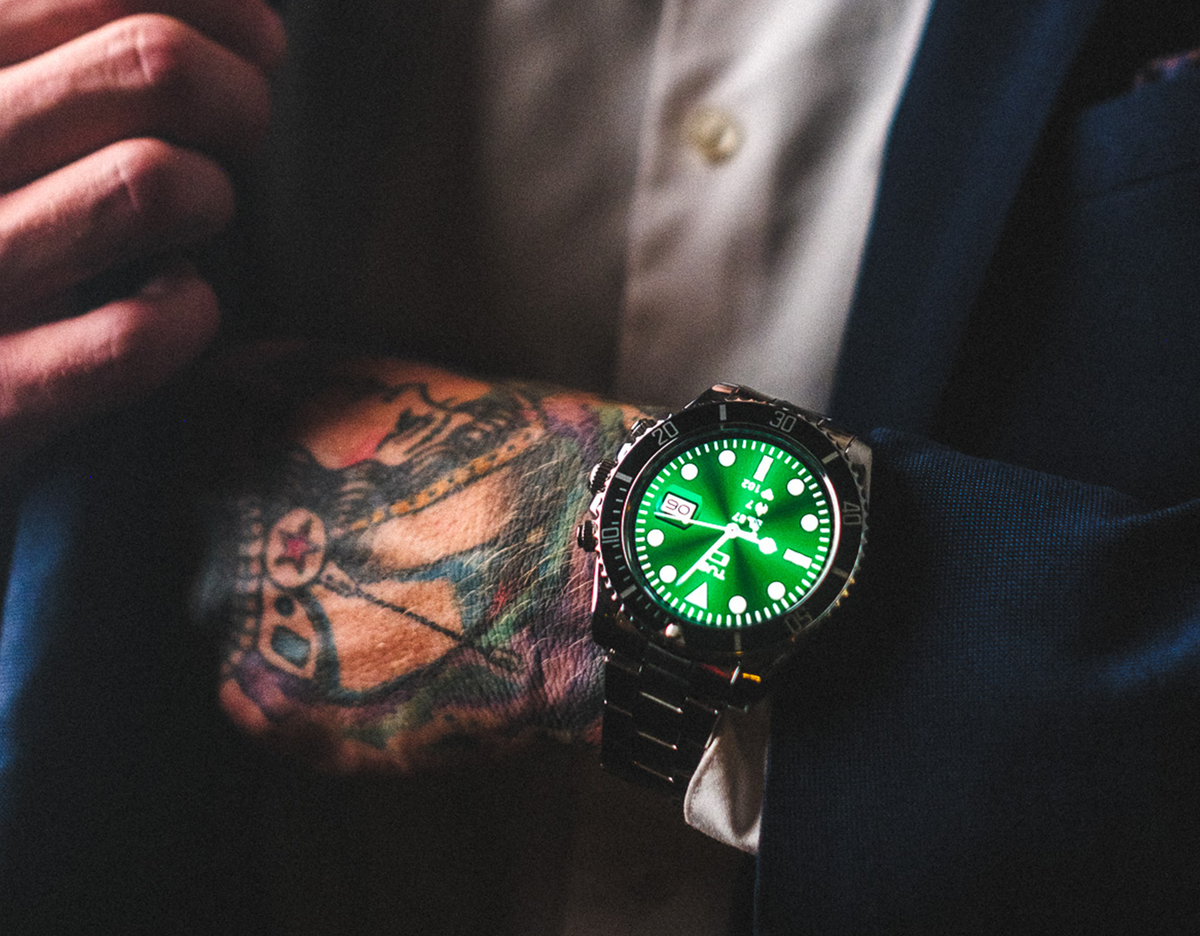
The most confident man in this room is also wearing the cheapest watch. This is not a coincidence.
The Question Nobody Asks Out Loud
- 1 True confidence doesn't need an audience. The watch does. The Core Argument
- 2 Every truly unshakeable man I've studied wears something you wouldn't notice.
- 3 The $20,000 Rolex is not a watch. It is a question — "do you respect me now?" — worn on the wrist.
- 4 The device replacing it costs $99 and doesn't ask anyone anything. Available Now
Here is the thing nobody says at the watch boutique, the golf club, or the corner table at the kind of restaurant where Rolexes are counted and noted: genuinely confident men are extraordinarily boring to watch.
They don't scan the room when they enter. They don't position their wrist during handshakes. They don't mentally note the brands on other men's wrists and feel — in some specific, unexamined way — either validated or threatened by what they find. They simply do not need the feedback loop that the luxury watch exists to provide.
This is not a moral judgment. It is a psychological observation. The expensive watch is a social tool. Its primary function is not timekeeping. It is the management of other people's perceptions. And the need to manage other people's perceptions is, at its root, the definition of insecurity — not weakness, not failure, but the ongoing, unresolved question of whether you are enough as you are.
Truly confident men have already answered that question. They answered it years ago, usually through something genuinely hard — a business that nearly killed them, a loss they had to survive, a war they came home from, a success so completely their own that no external symbol could add to or subtract from it. Once that answer is settled, the watch becomes irrelevant. And when the watch becomes irrelevant, they choose differently.
If your first instinct reading this was defensive — if you felt something that resembled irritation, the urge to explain your Rolex, or the need to list reasons it doesn't apply to you — sit with that feeling for a moment. This article is not for or against any watch. It is about the psychology underneath the purchase. The defensiveness, if it arrived, is information.
Checks his wrist during handshakes. Not for the time. To be noticed checking it.
Mentally catalogues other men's watches. Feels something depending on what he finds.
Spent $20,000 on something that tells him the time — and still feels the same in rooms that matter.
The Rolex is a down payment against anxiety. It didn't work. He's considering the Patek.
Describes the purchase as taste, heritage, investment. Has not examined whether any of that is true.
Does not think about his watch in rooms. Doesn't think about what others are wearing. Is entirely elsewhere.
Judges people by sharpness and outcomes. Has never once looked at a wrist to assess someone.
Wears what is useful. The Nexus Pro. A G-Shock. An old Seiko with sentimental value. Doesn't matter.
The question "what will this watch say about me?" genuinely doesn't occur to him. This is the clearest possible sign.
Chose the Nexus Pro because it actually does things. That was the entire calculation. Nothing else entered it.
What I Observed Across Three Years of Research
I spent three years studying men that most other men point to as paragons of the thing they're trying to build. Former commanding officers. Founders who built and exited eight-figure companies. Men who'd survived catastrophic failure and rebuilt without complaint. Partners in firms where the only currency is proven judgment.
The pattern across their wrists was striking. Almost none of them wore luxury timepieces as daily items. Some had them — inherited, gifted, kept for very specific occasions. But the watch on the wrist for every ordinary Tuesday, every board meeting, every difficult conversation, every early morning workout — was either nothing remarkable at all, or increasingly, a device like the Nexus Pro.
When I asked about it — and I did ask, directly — the answers were almost identical across every background and context: "It does things." "It tells me things I need to know." "I'm not really thinking about the watch." That last one is the most important. Not thinking about the watch is the goal. The $20,000 Rolex makes that impossible.
Most men reading this are somewhere between stage one and stage three. That's not a criticism — it's a description of where most men spend most of their productive lives. The question worth asking is not "where am I?" but "which direction am I moving?"
The watch that truly confident men choose isn't chosen for what it says about them. It's chosen for what it does for them. That sentence is the entire difference between a $20,000 signal and a $99 tool.
Conscious of the watch in every room. Always aware of whether it's being noticed.
Zero health data. Woke up tired, had no idea why. Blamed age, stress, diet — everything but ignorance.
$1,800 every 3 years to service something that tells time. Told himself this was sophistication.
Anxious near saltwater. Removed it before every swim. Kept it from the gym. Protected it from his own life.
Still in the performance phase. Still needing the room to notice. Still unresolved.
Doesn't think about the watch. Not once, in any room. That silence was the first signal something had changed.
Heart rate, SpO2, sleep staging, stress index — continuously tracked. For the first time, he understood his own body.
$0 annual maintenance. Not now. Not ever. The math became embarrassing within a single month.
Swims in it. Skis in it. Dropped it once on concrete. Not a mark. Stopped thinking about the watch entirely.
The performance ended. Nobody noticed — which turned out to be the point.

What the Nexus Pro Actually Does
This is the part where I'm supposed to say the confident man doesn't care about specs. He does. He cares about specs instead of brand names. The Nexus Pro earns the choice of the men described in this article not through heritage or logo recognition — but through what it measurably does for the life of a man who is no longer performing.
What It Does
Function over performance. Every single time. What the Nexus Pro does while your Rolex tells time and nothing else.
Monitors Your Heart Around the Clock
Heart rate, blood oxygen, atrial flutter detection, sleep staging, HRV — every minute of every day. Men who've switched report catching irregularities they'd been living with for years. The Rolex has never once tracked a single thing about your body. By design, it doesn't know you exist.
30 Days Per Charge. One Cable.
Charge it when you think about it. Wear it through everything else. No winding, no watchmaker, no $1,800 appointments, no "run it for 48 hours before it's accurate." It runs. Continuously. For a month. The Rolex needs winding like it's 1953. Mechanically, it is.
Built for the Life You Actually Lead
Aerospace-grade titanium. Take it into the ocean. Drop it on concrete. Wear it on a ski run and fall hard. Not a scratch. Not a ding. The Rolex was built for the life you want people to think you lead. The Nexus Pro was built for the other one.
Actually Waterproof. No Asterisks.
Not "water resistant to 30m — avoid extreme pressure changes." Waterproof. Swimmable. Wearable in any condition without a second thought. Men who spent years anxiously removing their Submariner before the pool describe the freedom of simply not thinking about it as one of the most unexpectedly significant changes of the switch.
Your Phone Stays in Your Pocket
Calls, messages, calendar, alerts — all from the wrist. Men who make this switch universally report that this feature — the most mundane to describe — changes the texture of daily life more than any other. Meetings feel different. The Rolex cannot connect to anything. It was designed in 1953 and has not been updated since.
The First Honest Mirror
Sleep staging, deep sleep percentage, HRV overnight, recovery score. Most men, seeing their actual sleep data for the first time, understand their energy and performance in ways that years of self-diagnosis never clarified. The Rolex sleeps on your nightstand and knows absolutely nothing about whether you actually rested.
I read this article, felt defensive, and ordered the Nexus Pro in the same sitting. My therapist says this is called "insight." I'm calling it the best $99 I've spent in ten years of being a person who cares too much about what other people think.
The Nexus Pro caught an arrhythmia at 2am on a Tuesday. Cardiologist when I landed in Singapore the next morning. Early AFib. Treated now. My $22,000 AP Royal Oak was in the safe. A $99 smartwatch tracked something that hadn't shown up in three years of annual physicals.
My colleagues noticed the switch. One asked if I was "going through something." I said yes — I was going through the realization that I'd been wearing a $20,000 clock to feel respected by men who weren't thinking about me. The Nexus Pro costs $99. I've thought about it less in six months than I thought about the Submariner every single day.
Sleep score from 58 to 81 in three weeks. I changed nothing except that I could now see what was happening. Four months later my doctor told me my bloodwork was the best in five years. The Nexus Pro gave me data about myself I'd been completely blind to. The Rolex gave me nothing except the feeling that I looked successful while falling apart.
The Comparison the Watch Industry Buries
| The Actual Question | $20,000 Rolex | $99 Nexus Pro |
|---|---|---|
| What it signals | I need you to know I succeeded | I stopped needing you to know |
| Daily functions | Tells time. Nothing else. | 100+ functions — health, connectivity, tracking |
| Health monitoring | None. Zero. By design. | HR, SpO2, sleep, stress, HRV — continuous |
| Battery / Power | Manual winding — daily ritual | 30 days per charge. One cable. |
| Annual cost | $1,500–$2,000 service | $0. Permanently. |
| Water & hard use | Anxiety and avoidance | Titanium. Fearless. Zero marks. |
| Connectivity | None. Was designed in 1953. | Calls, texts, apps, alerts |
| What it reveals | Still in the performance phase | Past it |

Confidence is not the absence of doubt. It is the presence of internal evidence so complete that external validation loses its urgency. The men described in this article did not arrive at that state because they bought the right watch. They arrived there because of what they did — the businesses they built, the failures they survived, the things they proved to themselves in private.
The watch came after. The choice of the watch was a reflection of something that had already happened internally. When the question "will they respect me?" is finally answered — answered by your own record, not by the brand on your wrist — the Rolex becomes irrelevant. And when it becomes irrelevant, you reach for the tool.
The Nexus Pro is a tool. A remarkable one. It monitors your heart, tracks your recovery, runs for a month on a charge, takes the ocean without complaint, and costs $99. It is the choice of men who've stopped asking their wrist to do their social work for them.
You may not be there yet. Most men aren't. But the direction of travel is what matters — and the $99 device sitting at northtime.com is, for many men, the first honest step in that direction. A step away from the performance. Toward the thing underneath it.
NorthTime is offering 10% off + free shipping on all Nexus Pro orders. Given the 120,000-unit waitlist this article helped create, availability at this price is genuinely limited.
This is not a sale in the traditional sense. It is a statement. A $99 smartwatch, discounted, shipped free, with a 60-day no-questions return window. There is no risk in the purchase. There is only the question of whether you're ready to try the honest calculation.
NorthTime 60-Day Zero-Risk Guarantee
Wear it for 60 days. Wear it hard. If it doesn't do more genuinely useful things in its first week than your luxury watch has done in the past year — send it back. Full refund. No questions. No forms. No hassle. This guarantee exists because NorthTime knows what happens when men who've been performing finally try the tool.
60-Day Returns
Full refund, no questions asked. Not 30 days. Sixty.
Free Shipping
Included on all orders. No minimum. No games.
Direct Support
Real help. No ticket system. No outsourced call center.
Since this article circulated privately among founders and operators, NorthTime's waitlist has passed 120,000. Pre-owned Rolex prices have declined an additional 6% this quarter. The disruption is not theoretical. It's measurable on both ends.
The men described in this article — the ones who've genuinely stopped performing — did not get there through a watch. The watch was just the reflection of something that had already changed. But for a significant number of men, the act of choosing the tool over the signal was itself the moment things began to shift.
The Nexus Pro is $99. It ships free. It comes with a 60-day guarantee. The only thing it cannot do is tell you that you've arrived. Which, if you think about it, is the entire point.






Verified Customers Voices

I couldn't be happier with my Nexus Pro! It’s tough enough to handle my demanding job, and I love that I can track my fitness right from my wrist. Plus, it keeps me connected without missing a beat!

It’s the first smartwatch that actually feels durable. I’ve dropped it a couple of times, and it still works perfectly. I highly recommend it to anyone who needs a reliable watch for everyday use.

I can’t believe how much I love my Nexus Pro! It’s comfortable to wear all day, and the notifications keep me on top of everything. It’s definitely made my life easier!

The Nexus Pro has truly exceeded my expectations! It’s stylish yet rugged, and I appreciate the health tracking features! So far I really like it!

I’ve tried a few smartwatches, but the Nexus Pro is by far my favorite. It’s user-friendly, and I love how it looks. Plus, it’s nice to know it won’t break if I bump it!

I never thought I’d find a smartwatch that could keep up with me, but the Nexus Pro has done just that. It’s sleek, functional, and tough enough for my active lifestyle

I’ve tried a few smartwatches before, but the Nexus Pro is the real deal. It’s lightweight, tough, and looks great. I can’t believe the value for the price!

I’m really impressed with the Nexus Pro. I’ve taken it hiking and to the gym, and it holds up great. Plus, the battery life is fantastic—it lasts for WEEKS!!